Invisible Braces Treatment in Delhi
Straighter Teeth, Without Announcing It
Invisible Braces Treatment in Delhi
Straighter Teeth, Without Announcing It

What are invisible braces?
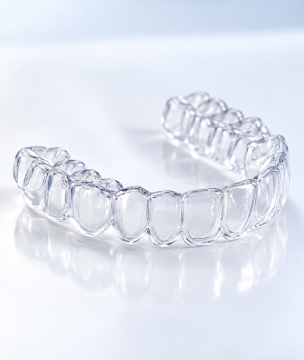
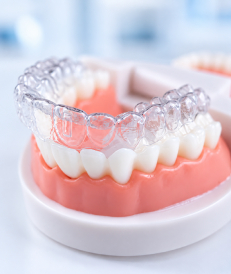
Invisible braces, commonly known as clear aligners, are a series of custom-made, transparent plastic trays that gradually shift your teeth into position. Each tray is worn for a set period before moving on to the next in the series, with the aligners being removable for eating, brushing, and flossing, unlike fixed traditional braces.
Why This Matters
Traditional braces work well, but the visible metal is genuinely a reason some people put off treatment they’d otherwise want, particularly adults who feel self-conscious about wearing braces at work or in everyday life. That hesitation is understandable, and it’s also exactly what clear aligners were designed to solve.
The teeth-straightening mechanism is fundamentally similar, gentle, steady pressure over time, but the way it’s delivered is nearly invisible and removable, which means eating, brushing, and flossing stay close to normal throughout treatment, something fixed braces don’t allow.
Is Invisible Braces Right for You?

Good Candidates
Mild to moderate crowding, gaps, or bite issues. Patients who want a discreet option and are disciplined enough to wear the aligners for the recommended hours each day, since results depend on consistent wear.

Cases Better Suited to Traditional Braces
More severe or complex misalignment sometimes still responds better to traditional braces, where the fixed wire allows for more controlled movement. Dr. Mathur will be upfront if this applies to your case.
What to Expect From Treatment
A custom set of clear aligners made specifically for your teeth, based on a detailed scan or impression
Each tray worn for roughly one to two weeks before moving to the next in the series
Aligners removed for eating and for brushing and flossing, then worn for the rest of the day and night
Periodic check-ins to track progress and receive your next set of trays. Curious whether your case is a good fit? That’s what the first consultation will tell you.
What Happens at Your Visit

Assessment
Dr. Mathur examines your teeth and bite to determine whether clear aligners are suitable for your specific case, or whether traditional braces would serve you better.

Digital planning
A scan or impression of your teeth is taken and used to plan the full sequence of aligners, from your starting position to the final result.

Wearing your aligners
You'll move through the series of custom trays at home, each one making a small, controlled shift toward your final position.

Progress check-ins
Regular visits confirm your teeth are moving as planned and let you collect your next set of aligners.

- Dr. Rajat Mathur
Advanced Dental Care & Smile Transformation in East Delhi
Dr. Rajat Mathur combines clinical expertise, modern dental technology, and a patient-first approach to provide comprehensive dental care designed around your comfort, oral health, and long-term smile.
- Experienced Dental Surgeon & Smile Expert
- Advanced & Minimally Invasive Dental Care
- Personalized Treatment for Every Smile
Frequently Asked Questions
It varies by case, commonly anywhere from six months to around two years, depending on how much correction is needed. Dr. Mathur will give you a realistic estimate after assessing your teeth.
For mild to moderate cases, yes, they can be just as effective. For more complex misalignment, traditional braces sometimes achieve a more precise result. This is assessed case by case.
Generally around 20 to 22 hours a day, removing them only for eating, and for brushing and flossing. Results depend heavily on consistent wear.
Yes, since the aligners are removed before eating, there are no food restrictions the way there often are with traditional braces.
Some pressure or mild discomfort when switching to a new tray in the series is normal for a day or two, but it's generally much milder than the adjustment discomfort of traditional braces.
They're genuinely difficult to notice in everyday conversation or photos, which is the main appeal for people who'd rather not have visible braces.
Yes, same as with traditional braces. A retainer keeps your teeth from gradually shifting back once active treatment is complete.
Treatment slows down, or in some cases the aligners stop fitting properly and need to be remade, which adds time and cost. Consistent wear is genuinely the most important part of the process.